Deficiency Trends: A Crucial Comparison Between TSMS and Coast Guard-Option Vessels
Subchapter M compliance remains a cornerstone of safe and efficient towing operations. One of the most telling indicators of compliance health is the rate of serious deficiencies—those that can halt operations or signal unsafe conditions. Understanding how different oversight models impact vessel performance is critical as the industry continues to evolve. Insights from the September 2025 TPO meeting, hosted by the Coast Guard’s Towing Vessel National Center of Expertise (TVNCOE) highlight clear performance differences between TSMS-option vessels and those using the Coast Guard-option.
Fleet Composition: The Foundation for Comparisons
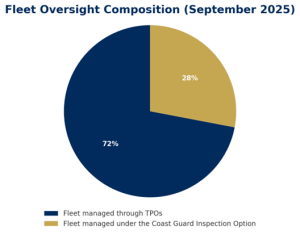
Understanding the makeup of the U.S. towing vessel fleet is essential for interpreting deficiency trends. CWO Jimmy Collins of the TVNCOE states that the fleet currently includes 4,869 towing vessels. Of these, 3,512 operate under a TSMS certificate or Document of Compliance (DOC) issued by a TPO or Responsible Organization (RO), with 2,875 specifically under the TSMS-option. This means approximately 72% of the fleet is managed through third-party oversight, while the remaining 28% falls under the Coast Guard inspection option. This disparity in oversight models provides a meaningful context for comparing serious deficiency rates.
Trends in Serious Deficiencies
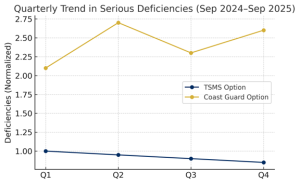
At the September 2025 meeting, Mr. Dave Phillips, Gulf Technical Advisor at the TVNCOE, presented metrics covering serious deficiencies from September 1, 2024, to September 1, 2025. These metrics focused on CG-835V action codes: Code 17 (Rectify deficiencies prior to departure), Code 30 (Restriction/No-Sail Condition), and Code 60 (Detention due to Unsafe Condition). The data was normalized to reflect ‘per vessel inspected’ rates for both TSMS-option and Coast Guard-option vessels.
Key findings from Mr. Phillips’ presentation include:
- Coast Guard-option vessels incurred more serious deficiencies per vessel inspected than TSMS-option vessels.
- The divergence is particularly notable for CG-835V codes 17, 30, and 60.
- TSMS-option vessels demonstrated a relatively steady or slightly declining deficiency rate over successive quarters, while CG-option vessels showed greater volatility and higher peaks.
TVIB’s Perspective on this Disparity
From the industry’s viewpoint, several factors contribute to the consistent outperformance of TSMS-option TPO/RO-overseen vessels in managing serious deficiencies:
- Proactive vs. reactive oversight: TSMS-option helps catch problems early, before they grow into bigger issues. This early action builds safety and confidence. Coast Guard-option vessels, however, may not discover issues until an inspection takes place.
- Slow fixes: When vessels aren’t regularly audited, problems can linger and get worse by the time inspectors find them.
- Inspection exposure: Annual Coast Guard inspections can uncover problems that have built up over time, while TSMS-option vessels benefit from continuous oversight that prevents issues from piling up. Ongoing monitoring gives operators confidence that potential problems are caught early.
- Structural differences among operators: Factors such as company size, maturity of management systems, and staffing levels influence how effectively deficiencies are identified and resolved.
- Policy and reporting: TSMS-option operators undergo a greater number of compliance activities overall, increasing the likelihood that deficiencies are identified and corrected before being noted by the Coast Guard.
Takeaways and Industry Implications
The data presented at the recent TPO meeting reinforces the value of the TSMS-option and provides actionable insights for operators:
- Shows why choosing the TSMS-option makes sense: The difference in serious deficiencies highlights the benefits of operating under TSMS-option with TPO/RO oversight.
- Applying data to support decisions: TVIB is gathering and sharing data on deficiency ratios so members can compare performance and keep improving.
- Focus on root cause and trend analysis: Beyond counting deficiencies, TVIB encourages members to “follow the audit trail”, investigating root causes, identifying common failure modes, and sharing lessons learned.
- Avoid complacency in TSMS-option fleets: Maintaining high performance requires ongoing vigilance, auditing, training, and management support.
The consistent trend of higher serious deficiency ratios among Coast Guard-option vessels underscores the effectiveness of the TSMS-option model. Every deficiency avoided translates to reduced downtime, fewer corrective actions, improved safety performance, and more substantial justification for choosing the TSMS-option path. TVIB’s unwavering commitment to supporting its members with tools, training, and resources instills optimism about the future of Sub M, driving continuous improvement across the industry.
For TVIB members, this is more than just a statistic—it’s a license to press forward. Every deficiency avoided means less downtime, fewer corrective actions, better safety performance, and more substantial justification for the TSMS-option path.